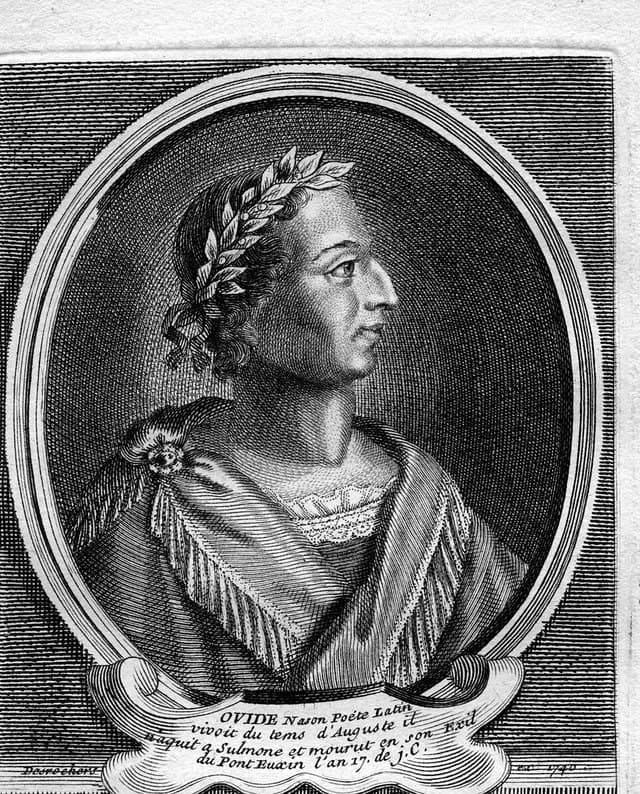
Étienne-Jehandier Desrochers · engraving, 1740s · public domain
AD 2 · Rome
Ovid
The first book anyone wrote about this
Part one does not begin with what to say. It begins with where to go: the theatre, the races and the busy covered walkways. These are places where it is normal to sit next to a stranger and nobody has to explain themselves. Then it tells the reader to watch her before he speaks, find out what she likes, and go where that is. Two thousand years later, that is still the best first step. Part three gives women the same advice, and most of the books that copied him left that out.
Source · Ovid, Ars Amatoria I (AD 2); Tristia II; Wikipedia, Ovid and Ars Amatoria
Principle 02 · our reading
Ask, do not assume
Taught in Topic 01 · First Contact
Why we teach it
The exercises here most often ask for two things: choose the place, and pay attention to the other person before you speak. This is the oldest written record of both. They work for the same reason. It is hard to feel watched while you are busy noticing someone else, and a place you already know gives you one less thing to be nervous about.
The exercise
Before you speak to anyone this week, watch the room for two minutes and find one true thing about the person you want to talk to. Start with that.
The warning
One passage in part one tells the reader to use force, and claims that women want it: “vim licet appelles: grata est vis ista puellis”, which means “call it force, that force pleases girls”. The lines around it tell him to continue when she says no. Many classical scholars today read this part of the poem as a description of rape. They read it that way because of what the Latin says, not because it makes modern readers uncomfortable. Parts of the book are also a joke at its own expense, and scholars disagree about how much. Neither point makes those lines any better. This is the clearest example of what we mean when we say we remove the manipulation. We keep the part about paying attention, and we throw away the part about ignoring an answer.
Who Ovid was, and why we chose him
43 BC – AD 17
Publius Ovidius Naso was born on 20 March 43 BC in Sulmo, in the mountains east of Rome. He became the most famous poet in Rome and wrote the Metamorphoses, which people still read. In AD 2 he published Ars Amatoria, The Art of Love. It is a handbook in three parts: how to find someone, how to keep them, and in part three the same advice written for women. Six years later the emperor Augustus sent him into exile in Tomis, a town on the Black Sea at the edge of the empire. He spent the rest of his life there, writing letters home and asking to return. He was never allowed back. He died in AD 17 or 18. He said he was exiled for “a poem and a mistake”, and he never said which poem or what mistake.
Why we chose them · our reading
We chose him because he wrote the first book on the subject. Every later book is arguing with his handbook from AD 2, usually without saying so. We could not leave him out. He is also the best reason to read these people carefully and not simply copy them. Some of his advice is truly useful and some of it cannot be defended, and both are in the same chapter.
Ovid’s principle is practiced in Topic 01, First Contact: a 2:22 video and 10 real-life exercises.
The other masters
- Cleopatra VII — She made him come to her
- Ninon de l’Enclos — She ended things warmly, on purpose
- Giacomo Casanova — What his memoirs really show
- Madame de Pompadour — She brought a world with her
- Lord Byron — Why being unavailable is not a strategy
- Gabriele d’Annunzio — Proof that attention matters more than looks
- Grigori Rasputin — His enemies invented most of his legend
- Marilyn Monroe — She could switch it on
- Joséphine Baker — Being playful worked better than being polished