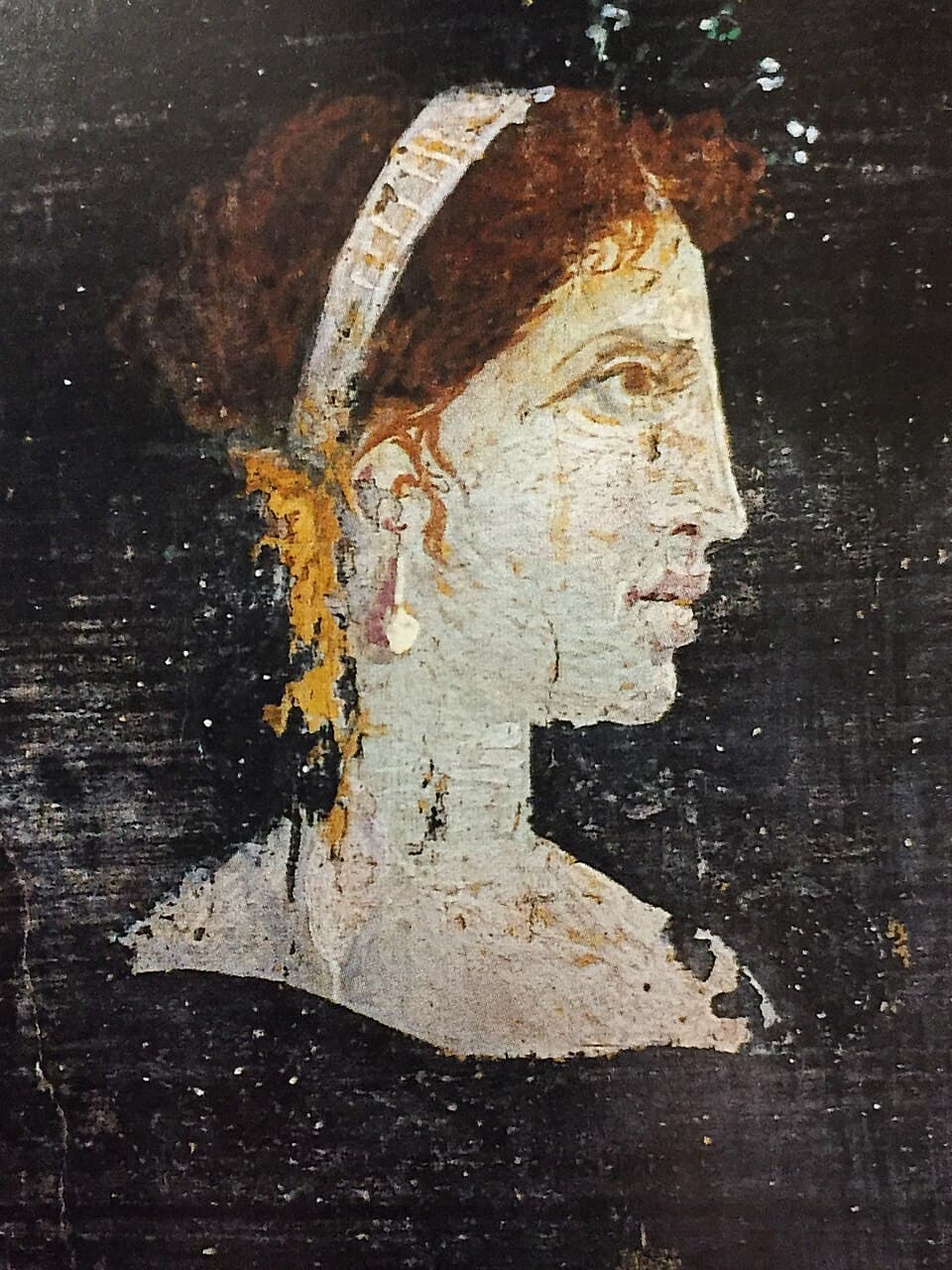
Roman painting from Herculaneum, possibly Cleopatra · 1st c. AD · public domain
41 BC · Tarsus
Cleopatra VII
She made him come to her
Mark Antony ordered her to come to Tarsus to explain Egypt's behavior. She ignored his letters. Then she arrived on her own ship, with a golden stern and purple sails, dressed as Aphrodite. She refused his invitation to dinner, so he came on board to her. Plutarch did not admire her, but he records that her real power was in conversation: the charm of her voice, and how easily she moved between languages.
Source · Plutarch, Life of Antony 25–27
Principle 01 · our reading
Arrive on your own terms
Taught in Topic 01 · First Contact
Why we teach it
Choosing the place is the easiest way to reduce anxiety. A familiar place measurably lowers stress before an event.
The exercise
This week, choose the place for one meeting yourself, and do not simply accept the one you are offered. Choose somewhere you can clearly be yourself.
The warning
The ship was only the setting. The substance was that she had studied Roman politics for years beforehand. A show with no preparation behind it is easy to see through, and it looks like an act.
Who Cleopatra was, and why we chose her
c. 69 – 30 BC
She was the last active ruler of Ptolemaic Egypt, and the last of a Macedonian Greek family that had held the throne for nearly three hundred years. She came to power at about eighteen. Her brother's court removed her, and she took the country back with a Roman army behind her. She is reported to have spoken several languages, including Egyptian, which was unusual in her family. She governed a rich country with plenty of grain for twenty-one years while Rome fought itself. She died in 30 BC, about ten days after Antony, as Octavian took Alexandria.
Why we chose them · our reading
Everyone knows the story of her ship, and the ship is the least interesting thing about her. She had studied Roman politics for years before she staged that arrival. The show worked because the preparation was already done. We chose her as the argument against treating appearance as the skill.
Cleopatra’s principle is practiced in Topic 01, First Contact: a 2:22 video and 10 real-life exercises.
The other masters
- Ovid — The first book anyone wrote about this
- Ninon de l’Enclos — She ended things warmly, on purpose
- Giacomo Casanova — What his memoirs really show
- Madame de Pompadour — She brought a world with her
- Lord Byron — Why being unavailable is not a strategy
- Gabriele d’Annunzio — Proof that attention matters more than looks
- Grigori Rasputin — His enemies invented most of his legend
- Marilyn Monroe — She could switch it on
- Joséphine Baker — Being playful worked better than being polished