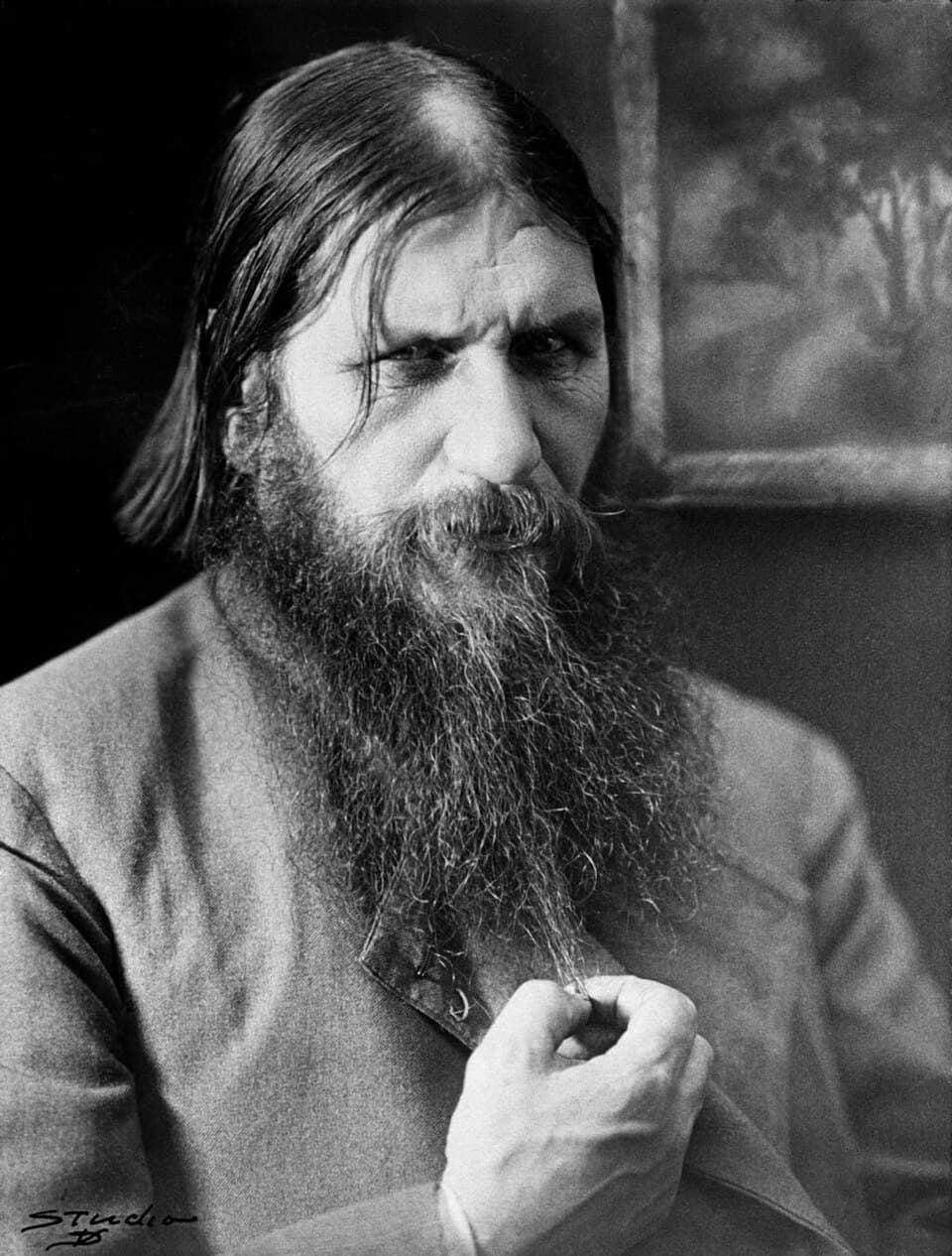
Photograph, 1916 · public domain (Russian Empire)
1905–16 · St Petersburg
Grigori Rasputin
His enemies invented most of his legend
The legend describes a man of endless appetite who controlled everyone around him. The records show someone different. He was tall and long-haired, and the people who met him wrote most about his eyes. He offered an isolated imperial family complete certainty and his full attention, and nobody else at court offered either. His standing depended on the Tsarevich’s haemophilia. His calm seemed to steady the household. Some historians think that by keeping the doctors away, he may have stopped the boy's aspirin, a blood thinner that nobody then knew was making him worse.
Source · Douglas Smith, Rasputin (2016); Antony Beevor, Rasputin
Principle 13 · our reading
Certainty spreads to other people
Not taught. Included as a control case.
Why we teach it
People regularly take confidence for ability, even when the two are unrelated. This is useful in two ways. It explains his hold on the family, and it explains why another person's certainty is not evidence of anything.
The exercise
There is no exercise. Read this as a warning about the people you find magnetic.
The warning
Historians find that his political influence has been greatly exaggerated, and that the rumors about him did far more damage than his actions. He was unfaithful to his wife and he drank heavily. The real story is how much authority a frightened family will give to anyone who sounds sure.
Who Rasputin was, and why we chose him
1869 – 1916
He was a Siberian peasant. After a pilgrimage and a religious conversion in 1897, he travelled as a strannik, a religious wanderer, and reached the imperial court. He held no position in the Russian Orthodox Church. His standing depended almost entirely on the haemophilia of the Tsarevich Alexei and the Empress's belief that he could help. His calm seemed to steady the household. Conservative nobles murdered him at the Yusupov Palace in December 1916. Douglas Smith's 2016 biography argues that his political influence was much smaller than the legend says, and that the rumors did far more damage than the man.
Why we chose them · our reading
He shows most clearly that certainty spreads to other people, and he is the clearest warning about how little that certainty is worth. He offered an isolated family complete conviction and his full attention, and nobody else at court offered either. People took his confidence for ability. They were wrong, and they did it anyway. This explains his hold on them. It also explains why another person's certainty is not evidence of anything.
The other masters
- Ovid — The first book anyone wrote about this
- Cleopatra VII — She made him come to her
- Ninon de l’Enclos — She ended things warmly, on purpose
- Giacomo Casanova — What his memoirs really show
- Madame de Pompadour — She brought a world with her
- Lord Byron — Why being unavailable is not a strategy
- Gabriele d’Annunzio — Proof that attention matters more than looks
- Marilyn Monroe — She could switch it on
- Joséphine Baker — Being playful worked better than being polished