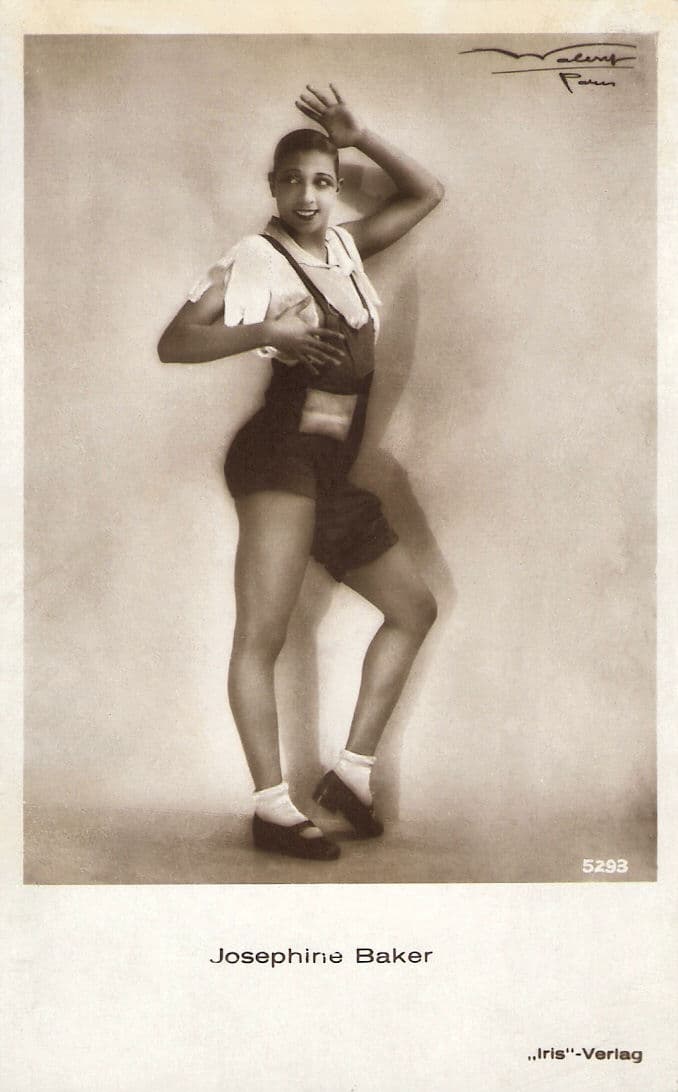
Studio portrait by Lucien Waléry, published before 1931 · public domain
2 Oct 1925 · Paris
Joséphine Baker
Being playful worked better than being polished
She was nineteen and wanted to sing. She was hired as a comic for La Revue Nègre at the Théâtre des Champs-Élysées. The material she was given was built on a crude "exotic" fantasy. She undermined it from inside: she crossed her eyes, puffed out her cheeks, and moved in sudden jerks on purpose. Her comedy kept interrupting the eroticism that the producers had ordered. By the end of the night, Paris loved her.
Source · Contemporary reviews; Phyllis Rose, Jazz Cleopatra
Principle 12 · our reading
Playful works better than polished
Taught in Topic 03 · Desire & Restraint
Why we teach it
Being playful shows that you are not a threat, and attraction cannot start without that. Being polished shows effort, and effort makes people judge you. Being judged is exactly what most shy people want to escape.
The exercise
Do the slightly silly version of something you were going to do carefully. Notice who moves closer.
The warning
She was working inside a racist idea that she did not choose, and undermining it was as much about survival as about flirting. Play also stops working the moment you do it for approval and not because you enjoy it.
Who Baker was, and why we chose her
1906 – 1975
She was born Freda Josephine McDonald in St. Louis. She arrived in Paris at nineteen and became one of the most successful entertainers in Europe. She gave up her US citizenship and became French in 1937. During the Second World War she worked for French military intelligence. She carried information written in invisible ink on sheet music, and she sheltered refugees at her château. She received the Resistance Medal and the Croix de Guerre, and she was made a Chevalier of the Légion d'honneur. She spoke at the 1963 March on Washington. In 2021 she was honored at the Panthéon, the first Black woman to be. The coffin placed there holds soil from places where she lived. Her body remains in Monaco.
Why we chose them · our reading
On her first night in Paris, she was given material built on someone else's racist fantasy. She made it her own by refusing to play it seriously. She crossed her eyes, puffed out her cheeks, and was funny where the script wanted her to be exotic. Being playful worked better than being polished, in front of the hardest possible audience. The warning about her matters more than any other on this page: undermining that racist idea was a way to survive before it was charm.
Baker’s principle is practiced in Topic 03, Desire & Restraint: a 1:36 video and 10 real-life exercises.
The other masters
- Ovid — The first book anyone wrote about this
- Cleopatra VII — She made him come to her
- Ninon de l’Enclos — She ended things warmly, on purpose
- Giacomo Casanova — What his memoirs really show
- Madame de Pompadour — She brought a world with her
- Lord Byron — Why being unavailable is not a strategy
- Gabriele d’Annunzio — Proof that attention matters more than looks
- Grigori Rasputin — His enemies invented most of his legend
- Marilyn Monroe — She could switch it on